The Corners You Ignore Are Keeping Secrets About You
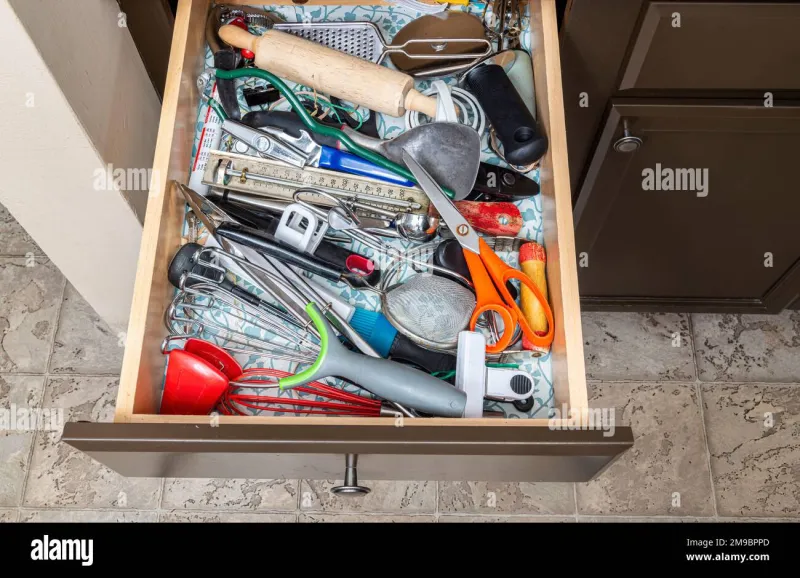
Photo: messy junk drawer open kitchen home organization, via c8.alamy.com
There's a drawer in most of our homes. You know the one. It's somewhere between the kitchen and the dining room, or maybe it's that cabinet in the hallway nobody opens without a reason. It's stuffed with dead batteries, takeout menus from restaurants that closed in 2019, rubber bands that have lost all their elasticity, and at least one key that unlocks something you can no longer remember. You walk past it every single day. You never open it. And somehow, it never crosses your mind — until it does, and then you close it immediately.
That drawer is telling you something. So is the pile of clothes at the back of your closet that you haven't touched since you moved in. So are the forty-seven browser tabs you've had open since March. So is the stack of mail on the corner of your kitchen counter that you keep meaning to sort through.
Here's the thing: we spend so much energy curating the visible parts of our lives. We style our bookshelves. We carefully arrange our coffee table. We edit our wardrobes and our Instagram grids and the way we show up in meetings. But the spaces we avoid? Those are the unedited version. And they're probably the most honest thing about us right now.
Why We Avoid Instead of Address
Avoidance isn't laziness. That's worth saying clearly because most of us have been conditioned to believe that the clutter we accumulate is a personal failing — a sign that we're disorganized or overwhelmed or just not trying hard enough. But avoidance is almost always a form of protection.
When something feels too big, too complicated, or too emotionally loaded, our brains do us the favor of just... not looking at it. The junk drawer becomes a symbol of everything we haven't dealt with. The back of the closet holds the clothes from the version of yourself you're not sure you're done being yet. The browser tabs are unfinished thoughts, half-researched ideas, and the fifteen recipes you saved during a hopeful Sunday afternoon when you genuinely believed you'd learn to cook something new.
These spaces accumulate the in-between stuff — the decisions that didn't feel urgent enough to make, the things that didn't have a clear place. And over time, they become harder to face, not because the actual mess is so terrible, but because of what the mess represents.
The Junk Drawer as Emotional Archaeology
I've started thinking about neglected spaces as a form of emotional archaeology. When you finally open that drawer or sort through that pile of mail, you're not just dealing with physical objects. You're sifting through evidence of who you were, what you were hoping for, and what you kept putting off.
That gym membership confirmation email from 2022 you never opened? That's not just spam. That's a conversation you've been avoiding with yourself about your health and what you actually want. The half-finished journal at the back of your nightstand drawer? That's a creative impulse you started and then quietly talked yourself out of. The expensive face cream you bought and never used? That's a whole story about self-care and whether you actually believe you deserve it.
None of this is meant to make you spiral. It's meant to make you curious. Because when you approach your avoided spaces with curiosity instead of judgment, something shifts. You stop seeing the mess as a problem and start seeing it as information.
The Browser Tab Problem Is Real
Let's talk about digital spaces for a second, because they're the modern version of the junk drawer and we don't address them nearly enough. The tabs you can't bring yourself to close, the emails you've read but left marked as unread, the notes app full of ideas that have never gone anywhere — these are the digital equivalent of the pile on the counter.
Every open tab is a micro-commitment. A little whisper of I should look into this or I'm not done with this yet or I might need this later. And when you have forty of them? That's forty micro-commitments running in the background of your brain, quietly eating up processing power you could be using for something else.
Closing a browser tab you've been holding onto for months isn't giving up. It's making a decision. And making decisions — even small ones — is one of the fastest ways to feel like yourself again when life has started to feel a little foggy.
What Happens When You Actually Deal With It
Here's the part that surprises people: cleaning out a neglected space almost never feels like just cleaning out a neglected space. It feels like something unlocking.
There's a reason people report feeling creatively unstuck after they reorganize a room, or emotionally lighter after they finally go through a box they've been moving from apartment to apartment for a decade. The physical act of addressing something you've been avoiding sends your nervous system a message: You can handle things. You're not stuck. You're capable of moving forward.
It doesn't have to be dramatic. You don't need to spend a whole weekend on a deep clean or hire a professional organizer. Start with one drawer. One pile. One batch of browser tabs. Give yourself twenty minutes and no agenda beyond just looking at what's actually there.
You might find that the thing you've been avoiding wasn't as heavy as you thought. Or you might find that it was exactly as heavy as you thought, and now at least you know what you're actually dealing with.
Making Peace With the Unfinished
Not everything in your neglected spaces needs to be resolved. Some browser tabs can stay open because you genuinely will come back to them. Some clothes at the back of the closet can stay because you're not ready to let go yet, and that's okay. The point isn't to achieve some kind of perfect, empty, minimalist existence where nothing is unfinished.
The point is to be honest with yourself about what you're holding and why.
The spaces you avoid are not your failures. They're your humanity. They're proof that you're a person with more ideas than hours, more intentions than energy, more versions of yourself than any single moment can hold. The only question worth asking is whether you're avoiding them out of genuine peace — I'll get to it when I'm ready — or out of anxiety, which is a different thing entirely.
One is self-awareness. The other is worth a closer look.
So the next time you walk past the drawer and feel that familiar impulse to keep moving, maybe pause for a second. Ask yourself what's actually in there — not just physically, but emotionally. What have you been protecting yourself from? What might be ready to be released?
Your curated spaces show the world who you want to be. Your avoided ones? They show you who you actually are right now. And that version of you deserves attention too.