What's Actually on Your Table Says More About You Than What's in Your Closet
What's Actually on Your Table Says More About You Than What's in Your Closet
There's a version of your life happening at your kitchen table every night. Or maybe it's on your couch, with your phone propped against a throw pillow and a takeout container balanced on your knee. Maybe it's standing at the counter, eating cold pasta straight from the pot because sitting down felt like too much commitment for a Tuesday.
None of that is a judgment. But it is information.
We've become pretty fluent in the language of personal style — we know that what we wear communicates something, that our living rooms send a signal, that the way we decorate a bookshelf is a form of self-expression. And yet somehow, the dinner table — this ritual we return to multiple times a day, every single day of our lives — gets treated like a logistical problem to solve rather than a space worth actually thinking about.
That's worth examining.
The Table Tells the Truth
Here's the thing about mealtime: it's one of the few moments in your day that has the potential to be genuinely intentional. It's not a commute or a meeting or a task you're moving through. Eating is something you're supposed to actually be present for. And yet, for most of us, it's become the most distracted part of the day.
Think about what your average dinner actually looks like right now. Are you sitting at a table or on a couch? Is the table set, or is it covered in mail, your laptop, and that tote bag you haven't unpacked since last week? Are you eating with someone, eating alone by choice, or eating alone by default? Are you tasting your food, or are you just fueling up while scrolling?
Again — not a guilt trip. A genuine audit. Because the gap between how you eat and how you want to eat is often a pretty accurate map of the gap between how you're living and how you want to be living.
Mealtime as Ritual, Not Routine
There's a difference between a routine and a ritual, and it mostly comes down to intention. A routine is something you do on autopilot. A ritual is something you've decided to show up for.
Intentional women — the ones who seem to have that particular kind of groundedness that's hard to fake — tend to treat mealtime like it matters. Not in a performance way. Not in a "perfectly plated grain bowl for Instagram" way. But in a quiet, private, this-is-mine kind of way.
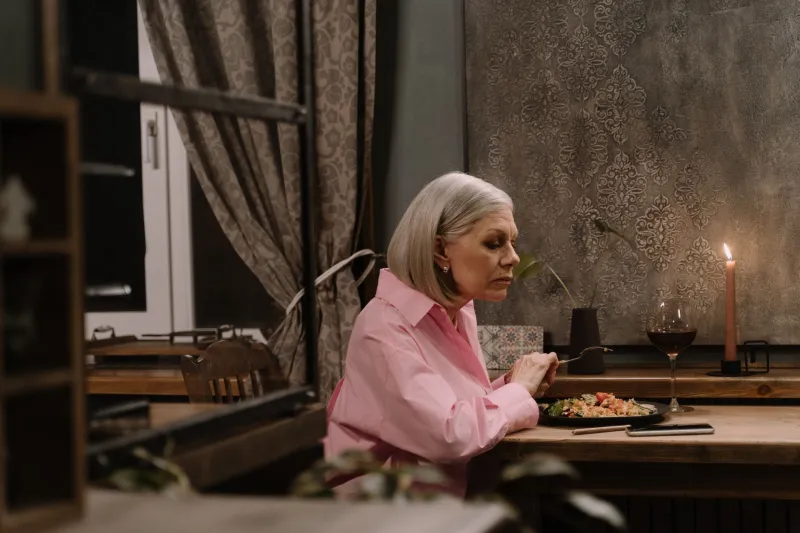
That might look like always eating at the table, even when you're alone. It might look like owning one set of ceramics you actually love — not the ones that came with the apartment, not the mismatched ones from three different relationships ago, but pieces you chose because they make you happy to look at. It might look like lighting a candle at dinner not because anyone's coming over but because you are.
These aren't grand gestures. They're small ones. But they compound.
Your Eating Environment Is a Design Choice
When people talk about intentional living, they usually mean big things: your career, your relationships, your morning routine. But design — real design, the kind that shapes how you feel day to day — lives in the details.
The ceramics you eat off of. Whether your table has a plant on it or a pile of unopened mail. Whether you own cloth napkins or always default to paper towels. Whether you actually sit down or eat standing over the sink. These are all choices, even when they don't feel like them.
If you've ever done a closet audit — pulled everything out, looked at it honestly, asked yourself what's actually serving you versus what you're just holding onto out of habit — try applying that same energy to your eating environment. Walk into your kitchen or dining area and look at it like a stranger would. What does it say? Does it say I take care of myself here? Does it say I'm just passing through? Does it say something you don't actually mean to say?
You don't need a dining room. You don't need expensive anything. You just need to be honest about what your current setup is communicating — and whether that aligns with the version of your life you're trying to build.
Eating Alone Is Not the Problem
One thing worth naming: a lot of women feel vaguely embarrassed about eating alone, like a beautifully set solo dinner is somehow sad or performative. It's neither.
Eating alone with intention — a real plate, maybe some music, no phone — is one of the most self-respecting things you can do. It says: I am worth the effort even when no one is watching. That's not a small thing. That's actually the whole thing.
The women who seem most comfortable in their own skin are usually the ones who've figured out how to enjoy their own company. And the dinner table, weirdly, is one of the best places to practice that.
Start Small, Start Honest
You don't have to overhaul your entire relationship with food or suddenly become someone who meal preps on Sundays and eats by candlelight every night. That's not the point.
The point is just to get curious. To notice. To ask yourself: What would it look like if I treated this meal like it mattered? And then, maybe, to try that once. See how it feels.
Maybe you buy one set of bowls you actually like. Maybe you clear the table and eat there tonight instead of on the couch. Maybe you put your phone in another room for twenty minutes and just eat, and think, and taste your food, and exist without performing or consuming anything other than your dinner.
Small shifts in how you eat ripple outward in ways that are hard to explain until you experience them. There's something about honoring the ordinary moments — the Tuesday nights, the lunches alone, the quick breakfasts — that makes everything feel a little more yours.
Your wardrobe gets a lot of attention. Your living room probably gets some. Your dinner table deserves a turn.
Because the life you're building? It's happening there too.